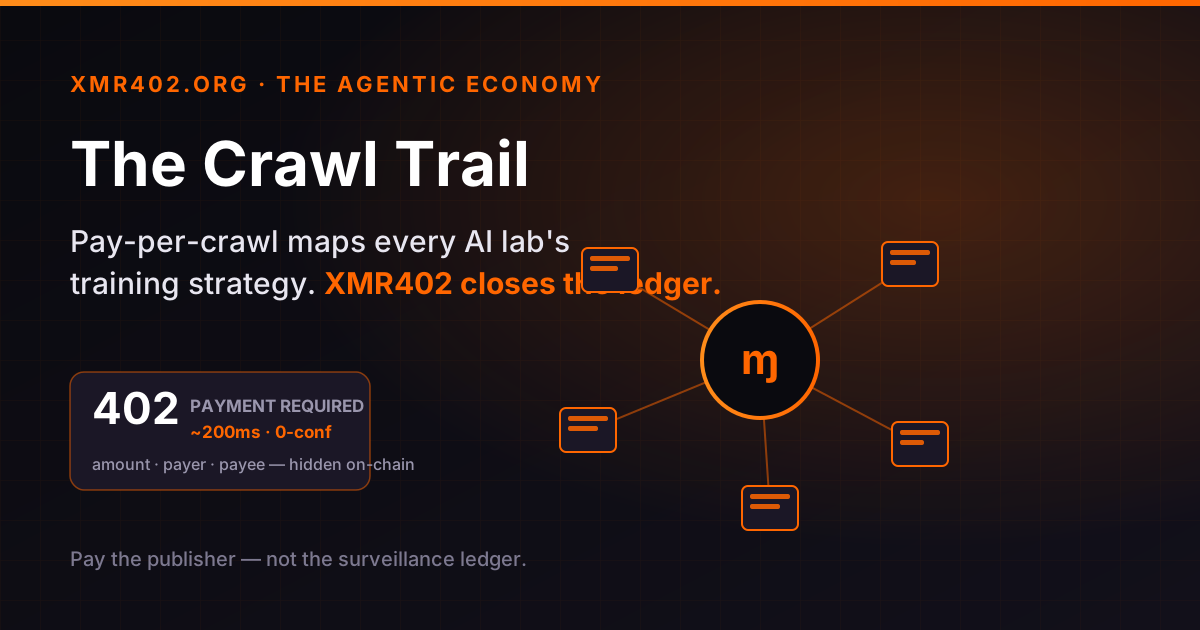
The Crawl Trail: How Pay-Per-Crawl Turns Every AI Lab's Training Strategy Into a Public Map — and Why XMR402 Closes the Ledger
In 2025, Cloudflare flipped a default that quietly rewired the economics of the web: AI crawlers are now blocked unless they pay. The company's pay-per-crawl marketplace lets publishers charge a fee every time a bot like GPTBot, ClaudeBot, or CCBot fetches a page, and in January 2026 it shipped an updated open-source x402 proxy template so any site can gate content per download, per API call, or per crawl. Sam Altman has publicly described the future of publishing as micropayments — "to be clear, payments made by AI agents, not readers directly."
It is the cleanest articulation yet of the agentic economy's supply side. For two years the conversation has been about agents buying services. Pay-per-crawl is about agents buying the raw material of intelligence itself: text, images, data, the corpus. And it arrives with a problem nobody is pricing in. When an AI lab pays for every page it crawls, the payment trail becomes a real-time map of what that lab is training on. On a transparent ledger, the most guarded secret in the industry — what's in the training set — leaks one micropayment at a time.
The corpus is the moat, and the rail is the leak
Crawling is not browsing. Cloudflare's own data shows training-related traffic now accounts for 79% of AI bot activity, and that some crawlers fetch on the order of tens of thousands of pages per referred visit. A lab acquiring training data at that intensity, paying per crawl on a public chain like USDC-on-Base, is publishing a structured feed of its R&D priorities: which domains it values, when it started ingesting a new vertical, how aggressively it is scaling a data category, and which competitor's content it considers worth licensing.
pie title What AI bot traffic is actually doing (Cloudflare data)
    "Training-related crawling" : 79
    "Search / retrieval" : 13
    "Other automated fetches" : 8
Consider what a transparent crawl trail hands to an observer. Every settled payment carries a payer address, a payee (the publisher), an amount, and a timestamp. Cluster the payee domains and you have reconstructed a rival lab's data acquisition strategy without breaching anything — the chain published it. A surge of payments to medical journals signals a healthcare model in training. A sudden contract with a legal-database publisher signals a vertical launch weeks before any announcement. This is the same surveillance tax that haunts agent purchases, but inverted onto the inputs — and the inputs are where the competitive value lives.
XMR402: pay the publisher, not the surveillance ledger
XMR402 is the Monero-native implementation of the open X402 standard. It uses HTTP 402 Payment Required to negotiate a payment, settles in Monero, and confirms in roughly 200ms via a Monero TX Proof at zero-confirmation — fast enough to gate a crawler that fetches thousands of pages a minute. Critically, Monero's protocol-level privacy means amounts, sender, and recipient are hidden by default. The publisher is paid and can cryptographically verify the payment; the world cannot read the ledger to reconstruct who paid whom for what.
sequenceDiagram
    participant Crawler as AI Crawler (Ripley Gateway)
    participant Edge as Publisher Edge (Ripley Guard)
    participant XMR as Monero
    Crawler->>Edge: GET /article
    Edge-->>Crawler: 402 Payment Required + price + address
    Crawler->>XMR: Send XMR payment
    Crawler->>Edge: Retry + TX Proof
    Edge->>Edge: Verify proof (~200ms, 0-conf)
    Edge-->>Crawler: 200 OK + content
    Note over XMR: Amount, payer, payee hidden on-chain
The stateless design matters as much as the privacy. There are no accounts to provision, no spending-limit dashboards, no per-call wallet confirmations — the failure mode that helped collapse transparent-rail x402 volume roughly 77% from its late-2025 peak. A crawler carries a budget, pays inline on each 402, and proves it. Nothing about the transaction is retained except the publisher's revenue.
Transparent pay-per-crawl vs. XMR402
| Dimension | Transparent rail (USDC/Base) | XMR402 (Monero) |
|---|---|---|
| Publisher gets paid | Yes | Yes |
| Crawl amounts public | Yes — visible to all | No — hidden on-chain |
| Payer/payee linkable | Yes — addresses cluster | No — stealth addresses |
| Training-corpus leakage | High — strategy reconstructable | None — no readable trail |
| Per-call confirmation | Often required | Stateless, inline 402 |
| Settlement speed | Block-time + conf | ~200ms, 0-conf TX Proof |
| Protocol fees | Varies | Zero |
Why this is the next battleground
The pay-per-crawl model is being built right now, and it is being built on transparent rails by default. That is a strategic mistake for the labs adopting it. A company will happily pay publishers to train on their content; it will not happily broadcast its entire training roadmap to competitors as a side effect of paying. The first lab to realize this will route its crawl budget through a private rail — and once one does, the rest cannot afford the asymmetry of training in public while a rival trains in the dark.
Publishers benefit too. A private settlement rail removes the chilling effect that stops some labs from licensing rather than scraping through laundered intermediaries like Common Crawl. If a lab can pay a publisher directly without revealing its hand, the honest path becomes the cheap path. Pay-per-crawl was supposed to fix the web's broken bargain between creators and machines. It only works if paying doesn't cost the payer its strategy. XMR402 closes the ledger — the publisher gets paid, and the corpus stays a secret.